
Are Minimalist Luxury Streetwear Trends 2026 Worth It?
Last Updated: October 25, 2026
Quick Summary
Minimalist luxury streetwear in 2026 is worth it if you buy fewer, better pieces built for longevity rather than drops. The trend is defined by restraint: fewer logos, better fabric, and cuts that hold their shape after a year of wear. Judge each piece by fiber content, construction, and cost per wear before you buy.
- A minimalist luxury capsule of 12 to 15 pieces produces well over 30 viable outfits.
- Put 50-60% of your budget into outerwear, the primary sneaker, and trousers.
- Every top must pair with every bottom, or the piece belongs outside the capsule count.
- A $220 overshirt worn three times a week for two years comes to roughly $0.70 per wear.
- Wash cold, inside out, and air dry to protect knit recovery and elastane.
Table of Contents
- Minimalist Luxury Streetwear Trends 2026: What Actually Changed
- Quiet Luxury Streetwear 2026: Muted Palettes and Minimal Branding
- Oversized Silhouettes, Clean Lines, and Precision Tailoring
- Minimalist Streetwear Outfits: Six Combinations That Work
- Luxury Streetwear Essentials: A Capsule With Item Counts
- How to Judge Fabric, Construction, and Cost Per Wear
- Styling by Climate, Occasion, and Body Proportions
- Building Your 2026 Rotation From Authentic Picks
- Frequently Asked Questions
Minimalist Luxury Streetwear Trends 2026: What Actually Changed
Minimalist luxury streetwear in 2026 is defined by restraint: fewer logos, better fabric, and cuts that hold their shape after a year of wear. At LFC DESIGNS ONE, customers ask for plain black tees, clean white sneakers, and pieces that work across seasons rather than one drop. Below: what changed, how to judge quality, and how to build a rotation that lasts.
Streetwear stopped competing on scarcity and started competing on longevity.
Minimalist Luxury vs. Quiet Luxury vs. Maximalist Streetwear
These three terms get used interchangeably, and that's a mistake. Minimalist luxury streetwear is a design approach: clean lines, minimal branding, relaxed fits, and premium materials built for daily wear. Quiet luxury avoids visible logos entirely, often in tailoring and knitwear. Maximalist streetwear is the opposite pole: loud graphics, oversized logos, limited drops, and color as the statement.
| Style | Branding | Silhouette | Buying Logic |
|---|---|---|---|
| Minimalist luxury streetwear | Small or tonal marks | Relaxed, tailored oversized | Cost per wear |
| Quiet luxury | Effectively none | Structured, tailored | Fabric and fit |
| Maximalist streetwear | Prominent, graphic | Very oversized | Drop timing and rarity |
The practical difference matters when you shop. A maximalist buyer asks "did I get the drop?" A minimalist buyer asks "will I still wear this in three years?" That question filters most of the market.
Quiet Luxury Streetwear 2026: Muted Palettes and Minimal Branding
Quiet luxury streetwear in 2026 runs on neutral tones: black, charcoal, bone, sand, olive, and navy, with one accent at most.
Minimal branding is the other half. A tonal logo, a small chest mark, or no mark at all reads more expensive than a large graphic, because it signals the wearer isn't paying for advertising space.
A muted palette isn't a restriction: eight neutral pieces produce more viable combinations than twenty loud ones, because every piece already coordinates with every other.
Oversized Silhouettes, Clean Lines, and Precision Tailoring
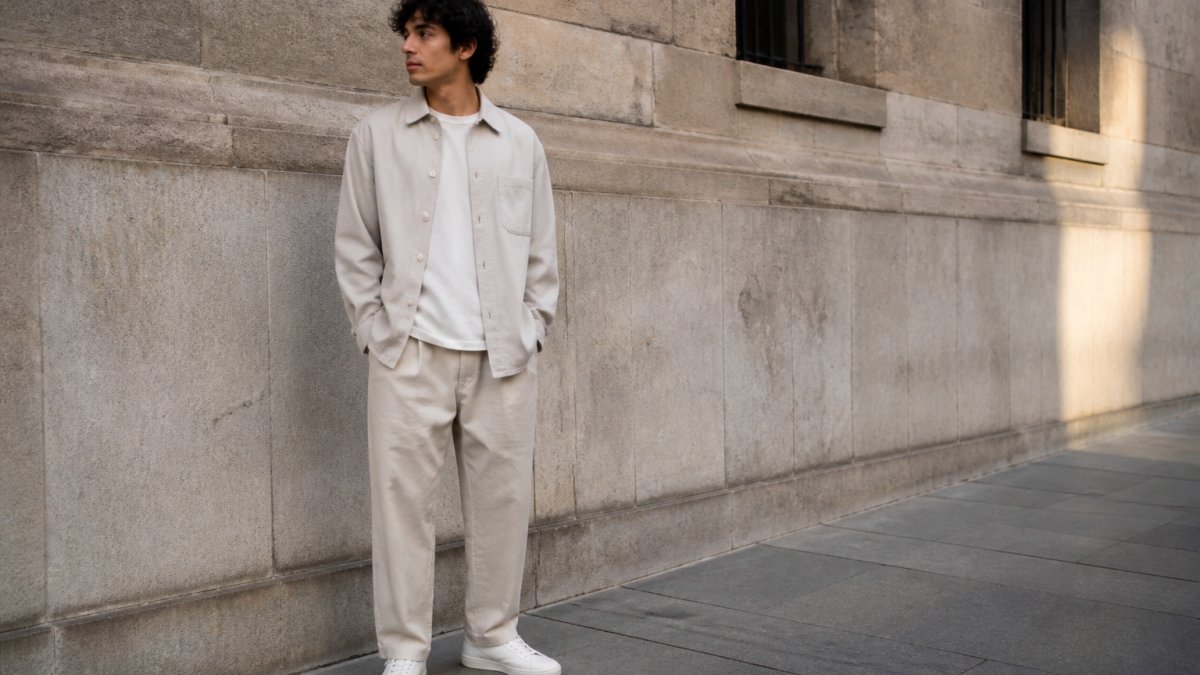
The oversized silhouette didn't disappear in 2026. It got tailored. Relaxed versus sloppy comes down to three measurements: shoulder seam, sleeve length, and hem break.
- Shoulder seam: should sit at or just past the natural shoulder, not halfway down the arm
- Sleeve length: ends at the wrist bone on a relaxed fit, never past the knuckle
- Hem break: trousers should break once, cleanly, over the shoe
Precision tailoring separates elevated streetwear from a size up. A cropped jacket or overshirt rebalances volume: wide through the body, short in length.
Watch out: buying two sizes up to chase the look usually fails at the shoulder seam, and no styling fixes a shoulder that's dropped too far.
Minimalist Streetwear Outfits: Six Combinations That Work
Minimalist streetwear outfits work when each look uses three tones and one focal point. These six combinations cover most occasions.
- The baseline: black tee, charcoal relaxed trousers, white low-top sneakers. Nothing to get wrong.
- The overshirt layer: sand overshirt open over a white tee, navy trousers, white sneakers.
- Elevated athleisure: gray crew sweatshirt, black jogger-style trousers, clean sneakers. Comfort without looking like the gym.
- Monochrome black: black tee, black trousers, black sneakers, with texture doing the work instead of color.
- The matching set: tonal set in olive or bone, plain white tee underneath, minimal sneakers.
- Smart casual crossover: navy polo, stone chinos, white sneakers. This is the one that works for dinner.
For the sneaker in looks 1 through 6, our PUMA Rebound Retro men's sneakers in white carry a retro basketball shape that reads clean against relaxed trousers, and the SOFTFOAM+ sock liner handles a full day on your feet.

Luxury Streetwear Essentials: A Capsule With Item Counts
A minimalist luxury capsule wardrobe for streetwear runs 12 to 15 pieces and produces well over 30 viable outfits. Adjust the counts to your climate and laundry habits.
- Tops (5): two plain tees in white and black, one gray tee, one polo, one overshirt
- Mid-layers (2): one crew sweatshirt, one zip or button layer
- Bottoms (3): relaxed trousers in black and navy, one pair of denim
The rule that makes this work: every top must pair with every bottom. If a piece only works with one other item, it's a statement piece, not an essential, and belongs outside the count.
The Outfit Math: Why 15 Pieces Beats 40
With 5 tops and 3 bottoms you get 15 top-bottom pairings before layering. Add the 2 mid-layers and the count climbs past 30 outfits; add the 2 footwear options and you cross 60 combinations from 15 items. That math only holds if every top coordinates with every bottom, which is why the three-tone palette is a structural requirement, not a style preference.
Run the check before you buy: hold the new piece against your three most-worn bottoms. If it fails even one, it doesn't enter the count.
Price Tiers and Buying Priorities
Luxury streetwear spans a wide price range, and capsule logic changes at each tier. The priorities below reflect how most buyers allocate a fixed budget.
| Tier | Typical Price Range (USD) | Where to Spend | Where to Save |
|---|---|---|---|
| Entry | Under $100 per piece | Footwear and outerwear | Tees, accessories |
| Mid | $100-$300 per piece | Outerwear, trousers, sneakers | Tees, mid-layers |
| Premium | $300+ per piece | Outerwear, footwear, tailoring | Basics you'll replace |
A common pattern is to put 50-60% of the budget into the three pieces you wear most: outerwear, the primary sneaker, and trousers. Those carry the most visible construction and daily abrasion. Tees and mid-layers wear out first regardless of price, so overpaying there rarely pays back in cost per wear.
Cost Per Wear Across the Capsule
Cost per wear settles most purchase arguments: divide the price by the realistic number of times you'll wear it. A $38.99 Nike Sportswear tee worn twice a week for a year lands under a dollar per wear, while a discounted graphic tee that pills after six washes costs more per wear.
PUMA Rebound Retro Men's Sneakers Color White Size 11 New In Box →
What to Buy First
Building from zero, order matters more than total spend. Start with the two sneakers and the black and navy trousers, which anchor the most combinations. Add the white and black tees, then the overshirt, then the outerwear.
Versatile pieces earn their place through fabric quality and durability, not how they photograph. A heavyweight cotton tee that keeps its shape after repeated washing beats three thin ones that pill by month four.
How to Judge Fabric, Construction, and Cost Per Wear
Fabric and construction decide whether a garment survives long enough to justify its price. You can evaluate both in under a minute, at the fiber, stitch, and drape level.
Fiber Content: Read the Label First
The label is the fastest quality signal available. Fiber content tells you how a garment behaves after ten washes, not just how it feels on the rack.
- 100% cotton: predictable shrinkage of roughly 3-5% on the first wash unless pre-shrunk. Look for "pre-shrunk" or "garment-dyed" on the label if you want to avoid surprises.
- Cotton-polyester blends: resist shrinkage and wrinkling but pill faster at friction points like underarms and cuffs. A blend sold as premium deserves scrutiny on the polyester percentage.
- Cotton-elastane (typically 2-5% elastane): adds recovery to trousers and tees, but the elastane degrades with heat. Wash cold and air dry to extend life.
Blends aren't automatically worse, but a high synthetic share in a garment sold as premium is the most common price-material mismatch.
Construction Checks You Can Run in a Minute
Turn the garment inside out. The inside tells you more than the outside.
- Seam finishing: look for clean overlock or flatlock seams with no loose threads at stress points, underarm, side seam, and crotch.
- Stitch density: a double-stitched hem and cuff outlast a single stitch. Count the stitches per inch on a visible seam; denser stitching generally signals better construction.
- Bartacks: small reinforced stitches at pocket corners and fly openings. Their presence is a reliable marker of a brand that expects the garment to be worn hard.
The Squeeze, Light, and Spring-Back Tests
Three quick physical checks catch most thin or low-quality knits before you commit.
- Hold it to the light. If you can see through a tee or sweatshirt clearly, the knit is thin and will likely lose shape.
- Squeeze and release. Good cotton springs back; cheap cotton stays creased.
- Stretch the hem gently. It should recover without a permanent wave. If it stays stretched, the elastane or knit structure is already tired.
Cost Per Wear: The Number That Settles the Argument
Cost per wear is the number that settles most purchase arguments. Divide the price by the realistic number of times you'll wear it. A $220 overshirt worn three times a week for two years comes to roughly $0.70 per wear, while a $90 alternative that loses its shape in eight months costs more than double that per wear.
Care and Longevity: The Part Most Guides Skip
Fabric quality only pays off with correct care. These habits extend the life of luxury streetwear more than any purchase decision.
- Wash cold, inside out, and air dry for tees, sweatshirts, and anything with elastane. Heat is the primary killer of knit recovery.
- Rest sneakers between wears and clean white leather with a soft brush and mild soap rather than machine washing.
- Repair before replacing. A re-stitched hem or replaced button costs a fraction of a new garment and preserves the cost-per-wear math.
A garment that survives three years of regular wear is the only kind that justifies a luxury price. The checks above are how you confirm it will before you pay for it.
Styling by Climate, Occasion, and Body Proportions
Styling rules change with conditions. In hot, humid climates, prioritize lightweight cotton tees and one overshirt, and keep trousers relaxed so air moves.
Occasion is the second filter. Elevated athleisure covers errands and casual work environments. A polo with chinos moves into dinner and informal meetings. Matching sets sit in between.
Body proportions are the third, and the one most guides skip:
- Shorter frames: cropped jackets and a single clean hem break keep the leg line long. Avoid very long tees.
- Taller frames: relaxed fits with a slightly longer body work better than cropped cuts, which can look undersized.
- Broader shoulders: drop-shoulder construction balances width; avoid raglan cuts that pull across the chest.
The goal is a silhouette that looks chosen, not inherited.
Building Your 2026 Rotation From Authentic Picks
Authenticity is the part of this trend nobody can style around. A counterfeit fails on fabric, stitching, and resale value, undermining the cost-per-wear argument minimalist luxury depends on. Buy fewer pieces, new with original tags, and verify the seller.
A rotation built this way looks smaller on the shelf and larger in the mirror. That's the point.
Frequently Asked Questions
What is quiet luxury streetwear?
Quiet luxury streetwear takes the relaxed shapes of streetwear and strips away loud logos, graphics, and hype drops. You get clean lines, minimal branding, neutral tones, and better fabric instead. Think a plain heavyweight tee, a boxy overshirt, straight-leg trousers, and a simple leather sneaker. The status signal comes from fit and material quality rather than a visible logo, which is why it holds up longer than trend-driven pieces and works across more occasions.
How do you style minimalist streetwear outfits without looking plain?
Build contrast with texture and proportion instead of color. Pair a smooth cotton tee with a brushed overshirt, or a cropped jacket with a longer relaxed trouser. Keep to two or three neutral tones, then add one deliberate detail: a visible stitch line, a tonal cap, or a clean white sneaker. Fit does most of the work, so get the shoulder seam and hem length right before adding anything else. A single well-fitted layer beats three stacked accessories every time.
What are the essential pieces for a minimalist streetwear wardrobe?
A workable starter set is roughly 12 to 15 items: three plain tees, two overshirts or button-downs, two pairs of relaxed trousers, one pair of tailored shorts, one lightweight jacket, one knit layer, one pair of clean sneakers, and a cap. Keep every piece in a neutral range so all of them combine. From that base you can build 20 or more outfits, which is why luxury streetwear essentials reward buying fewer, better items rather than chasing seasonal drops.
How do you check whether discounted designer pieces are authentic?
Check three things before you buy: the original tags and hangtags, the stitching consistency at stress points like shoulders and hems, and the label alignment inside the collar. Ask whether the item arrives new with original tags and whether the seller accepts returns if the tag is missing or the item arrives damaged. Sizing varies between designers, so confirm measurements rather than trusting a letter size. A seller that answers these questions directly is a better signal than any discount.
The hard part of minimalist luxury streetwear isn't finding the look. It's finding authentic pieces at a price that makes cost per wear work in your favor. LFC DESIGNS ONE stocks authentic designer tees, polos, caps, and sneakers, all brand new with original tags, with free shipping across the USA. Start with a plain black tee, a clean white sneaker, and one overshirt, and build from there. Get started with LFC DESIGNS ONE and build a 2026 rotation you'll still be wearing next year.
