
How to Spot Durable Fabric: 7 Practical Checks
Last Updated: November 4, 2026
Quick Summary
To identify durable fabrics, start by reading the fiber content on the care label, since longer, stronger fibers and well-chosen blends hold up better. Then inspect the weave or knit, the yarn density, and the seams, and check the care label to plan gentle laundering that extends the garment's life.
- Check the label for fiber content, since blends often combine comfort with strength.
- Hold fabric up to light: visible gaps usually signal loose construction that wears faster.
- Rub the surface briskly; quick pilling suggests a fabric prone to wear regardless of thread count.
- Double-stitched seams at shoulders and underarms last longer than single lines.
- Washing cold and line drying usually extends lifespan more than following a label's warm-wash setting.
Table of Contents
- Why Fabric Durability Matters Before You Buy
- 1. Check the Fiber Content on the Label
- 2. Examine the Weave and Knit Structure
- 3. Assess Yarn Density and Thread Count
- 4. Use the Touch Test to Identify Fabric Types
- 5. Compare Durable Fabric Blends
- 6. Inspect Seams, Stitching and Buttons
- 7. Read the Care Label and Plan Laundering
- Where to Find Durable Designer Pieces
- Frequently Asked Questions
Choosing durable fabrics is the difference between a shirt that survives thirty washes and one that pills, stretches and fades by the third. Before you spend money on a designer piece, a few minutes of inspection will tell you more than the brand name on the collar. LFC DESIGNS ONE offers authentic designer t-shirts, polo shirts, caps and sneakers. The seven checks below can be run on any garment, whether it comes from our catalog or somewhere else.

Why Fabric Durability Matters Before You Buy
Fabric quality determines how a garment wears, washes and ages, and durable fabrics keep their shape and color far longer than weak ones. A well-built piece keeps its shape and color through repeated laundering, while a weak one loses both quickly.
Durability depends on fiber, construction and finish together. A strong fiber woven loosely can still tear, and a tight weave of weak fiber can still pill. Keep that in mind as you read each check.
1. Check the Fiber Content on the Label
The care label lists fiber content by percentage, such as "100% cotton" or "60% cotton, 40% polyester." That line is the fastest clue to how a garment will hold up. Longer, stronger fibers generally produce more durable fabric, and blends often combine the strengths of two materials.
Natural Versus Synthetic Fibers
Natural fibers like cotton and wool breathe well and feel comfortable against the skin. Cotton can weaken and fade over time without proper care, and wool needs gentle handling. Synthetics such as polyester resist stretching, shrinking and wrinkling, and they dry quickly. Many durable everyday pieces use a blend, because the mix can offer comfort and resilience at once.
2. Examine the Weave and Knit Structure
Look at how the threads are organized. Woven fabrics, such as twill and canvas, interlace threads in a fixed pattern. Twill's diagonal ribbing adds strength and resists wear, while plain weaves are simpler but can be less strong. Ripstop weaves add reinforced grid lines that stop small tears from spreading.
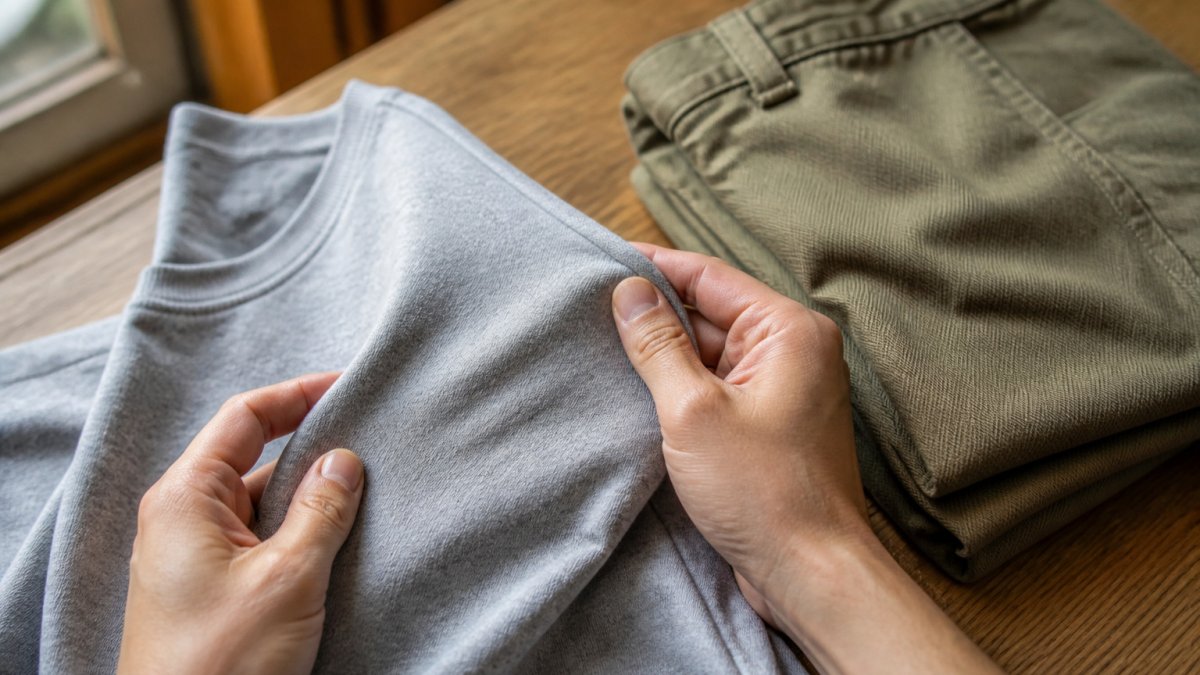
Knits, such as jersey, are made from interlocking loops. They stretch and recover well, which suits t-shirts and polos. Their durability depends on the yarn and how tightly the loops are formed.
3. Assess Yarn Density and Thread Count
Yarn density refers to how many threads or loops fit into a given space, and it is one of the few fabric properties you can partly judge with your hands and eyes in a store. Denser fabric usually resists abrasion and pilling better because there is more material to absorb friction before fibers break or work loose. For woven cotton, thread count is the common measure, but it can be misleading on its own.
Separate Fiber Quality From Construction
This is where most shoppers blur two different things. Fiber quality is about the raw material: staple length, fineness, cleanliness and consistency. Construction is about what happens after the fiber is spun: yarn twist, weave or knit density, finishing and garment assembly. A long-staple cotton in a loose, low-density weave can still wear out at the elbows, and a short-staple cotton in a tight weave can still pill on the surface.
Practical Density Checks You Can Do in a Store
- The light test. Hold the fabric up to overhead light. If you can see a clear pattern of gaps or the backing through the front, the density is probably low for a garment that will see frequent wear.
- The press test. Press the fabric between your fingers. It should feel solid and resist folding into tight creases. Fabric that collapses easily under light pressure tends to be thin or loosely constructed.
- The rub test. Rub the surface briskly with your thumb for a few seconds. Loose surface fibers that ball up quickly suggest a fabric prone to pilling, regardless of thread count.
- The stretch-and-recover check. Gently pull a knit across its width and release it. Good recovery means it snaps back close to its original shape; sluggish recovery points to yarns or loops that will sag over time.
- The seam-line look. Check how the fabric behaves next to a seam. Puckering or visible gaps along the stitch line often signal a loose weave or knit that will distort with wear.
Objective Durability Measures Worth Knowing
You do not need a laboratory to benefit from the standards labs use.
- Abrasion resistance measures how well a fabric withstands rubbing and scuffing. It is a useful predictor for cuffs, collars, pockets and seat areas, but it says little about tearing or seam failure.
- Tensile strength measures how much pulling force a fabric takes before it breaks. It matters for fitted garments and anything that gets stretched when you put it on.
- Tear strength measures how a fabric resists a rip once a small cut or snag exists. This is where ripstop weaves and tighter constructions earn their reputation.
- Pilling grades rate how much surface fuzz and small balls form after rubbing. Higher grades mean cleaner surfaces over time, which matters most on visible areas like chest and sleeves.
- Colorfastness rates how well dye stays put through washing, rubbing and light exposure. A durable fabric that fades in a few cycles still looks worn out.
Each measure predicts a different kind of failure. A fabric can score well on abrasion and poorly on tear strength, or hold color beautifully while pilling quickly.
Watch out: Thread count claims are easy to inflate by counting plies or using finer yarns, so treat a high number as a starting question rather than a durability guarantee.
4. Use the Touch Test to Identify Fabric Types
Run your hand across the surface and compare it to what the label promises. Cotton feels soft and slightly matte. Wool has a springy, warm feel. Polyester often feels smoother and a little slick, and very cheap synthetics can feel waxy.
Touch alone will not confirm fiber content, but a mismatch is worth noticing. A fabric that feels thin and papery despite a "heavyweight" claim deserves a closer look. Pair this check with the label and the weave inspection for a clearer picture.
5. Compare Durable Fabric Blends
Blends are common in durable clothing because they balance properties. Cotton-polyester blends are a frequent example: the cotton adds softness and breathability, while the polyester adds strength, shape retention and quicker drying.
Armani Exchange Men's Polo Color White NEW WITH ORIGINAL TAGS →
Consider how you will wear the garment. A polo for golf benefits from a blend that moves with you, while a fitted t-shirt worn daily may do best with a higher cotton content for comfort. Matching the blend to the job is more useful than chasing a single "best" fabric.
6. Inspect Seams, Stitching and Buttons
A durable fabric can still fail at the seams. Check that stitching is even, tight and free of loose threads.
Buttons should be firmly attached, with a thread shank or reinforced base. Give each button a gentle tug. Anything that wiggles or pulls loose is a sign of rushed construction.
Watch out: Printed logos and embroidered details can crack or fade faster than the base fabric. Inspect them as closely as the garment itself.
7. Read the Care Label and Plan Laundering
The care label is the manufacturer's instruction for keeping the fabric in good condition, but it is also a durability forecast if you read it closely. Machine-washable items with a low-heat dryer setting generally last longer than pieces that require delicate cycles and air drying, because gentler handling reduces the mechanical and thermal stress that breaks down fibers. Cold water and gentle cycles preserve color and reduce shrinkage, especially for cotton and blends. Plan your laundering before you buy, not after the first wash goes wrong.
How Care Affects Real-World Garment Lifespan
Most fabric failures people blame on poor quality actually happen in the laundry. Four mechanisms account for a large share of premature wear:
- Shrinkage. Cotton and some blends can shrink noticeably in hot water and high-heat drying. Repeated shrinkage stresses seams and hems, and a garment that no longer fits gets retired early regardless of fabric strength.
- Pilling. Friction in the wash and dryer loosens short surface fibers, which then ball up. Washing inside out, using gentler cycles and avoiding overloading reduce the friction that drives pilling.
- Fading. Dye loss comes from water temperature, detergent strength, abrasion against other garments and UV exposure during drying. Washing cold and line drying in shade keeps color longer than a hot wash and a hot dryer.
- Fiber fatigue. Every wash cycle bends and flexes fibers. Over time, repeated agitation weakens them even without visible damage, which is why a garment can look fine and then fail suddenly at a stress point.
Match Care to Fabric and Garment Type
Care needs differ by fabric and by garment purpose. Heavy cotton canvas workwear tolerates hotter washing than a lightweight knit tee, but it still benefits from gentler cycles if you want it to last. Wool needs cool water and flat drying to avoid stretching and felting. Synthetic performance fabrics often dislike fabric softener, which can coat fibers and reduce moisture management. Turn garments inside out, close zippers, use mesh bags for knits and delicates, and skip high-heat drying where possible.
Durability, Repairability and Cost Per Wear
Durability is not only about how long a fabric survives; it is also about whether the garment can be repaired and kept in use.
Watch out: Following the label exactly is not always the gentlest option.
Most fabric failures people blame on poor quality actually happen in the laundry; the table below lists the four common causes and how to reduce each one.
| Problem | Cause | Fix |
|---|---|---|
| Shrinkage | Hot water and high-heat drying | Wash cold and avoid high-heat drying |
| Pilling | Friction in the wash and dryer | Wash inside out on gentler cycles and avoid overloading |
| Fading | Hot water, strong detergent, abrasion and UV | Wash cold and line dry in shade |
| Fiber fatigue | Repeated agitation bending fibers | Use gentler cycles and mesh bags for knits and delicates |
Where to Find Durable Designer Pieces
Once you know what to look for, the next question is where to buy. Trustworthy sources matter as much as the fabric itself.
Our catalog includes authentic designer t-shirts and polos from brands such as Armani Exchange, Puma and US Polo Assn, all listed new with original tags.

Run these seven checks on any garment and you will quickly separate pieces built to last from those that will disappoint after a few washes.
Frequently Asked Questions
What are the most durable fabrics for clothing?
Denim, canvas, twill, wool and polyester blends consistently rank among the most durable fabrics for everyday clothing. Denim and canvas hold up to abrasion and frequent washing, while tightly woven twill resists tearing. Wool resists pilling when the fiber is long and the knit is dense. Match the fabric to how the garment will be worn: heavy canvas suits work wear, while a dense cotton jersey polo suits daily casual use. Check the fiber content and construction together rather than relying on fiber name alone.
How can you tell if clothing fabric is durable?
Combine several checks. Look at the fiber content, feel the density by holding the fabric up to light (tight, opaque weaves usually last longer), inspect seams and stitch density, and read the care label. A fabric that feels thin, shows gaps between threads or stretches out of shape quickly is unlikely to last. Durability also depends on how you wash and dry it, so a sturdy fabric still needs gentle care to stay intact over years of wear.
Do fabric blends make clothes more durable?
Often, yes. Blending cotton with a synthetic such as polyester adds strength and reduces wrinkling, while cotton contributes comfort and breathability. A common example is a cotton-polyester polo that keeps its shape after repeated washing. However, a blend is only as durable as its construction, so a loosely knit blend can still wear out faster than a dense single-fiber fabric.
